Track race formats
The Madison: track racing’s team event.
Two riders, one race. One of you races while the other rests up at the boards. Then you come down, hands meet, and a sling throws the fresh rider into the race. Sprints and laps score for the team.
Free on Ride Cave. Races need a smart trainer or power meter.
Hands meet, speed moves, and a fresh rider is back in the race.
How it works
A points race with a partner.
One races, one rests
Only the racing rider counts on the road. The other soft pedals high on the track, waiting for the partner to come round.
Make the exchange
As your partner comes round, wind up, drop down to meet them, and take the sling. Now you are racing and they are resting.
Score for the team
Sprints pay 5, 3, 2 and 1, the final sprint double. A lap gained on the bunch scores 20, a lap lost costs 20.
Win together
The team with the most points wins, and both partners take the same place.
The exchange
It all comes down to the sling.
Hands meet, speed moves.
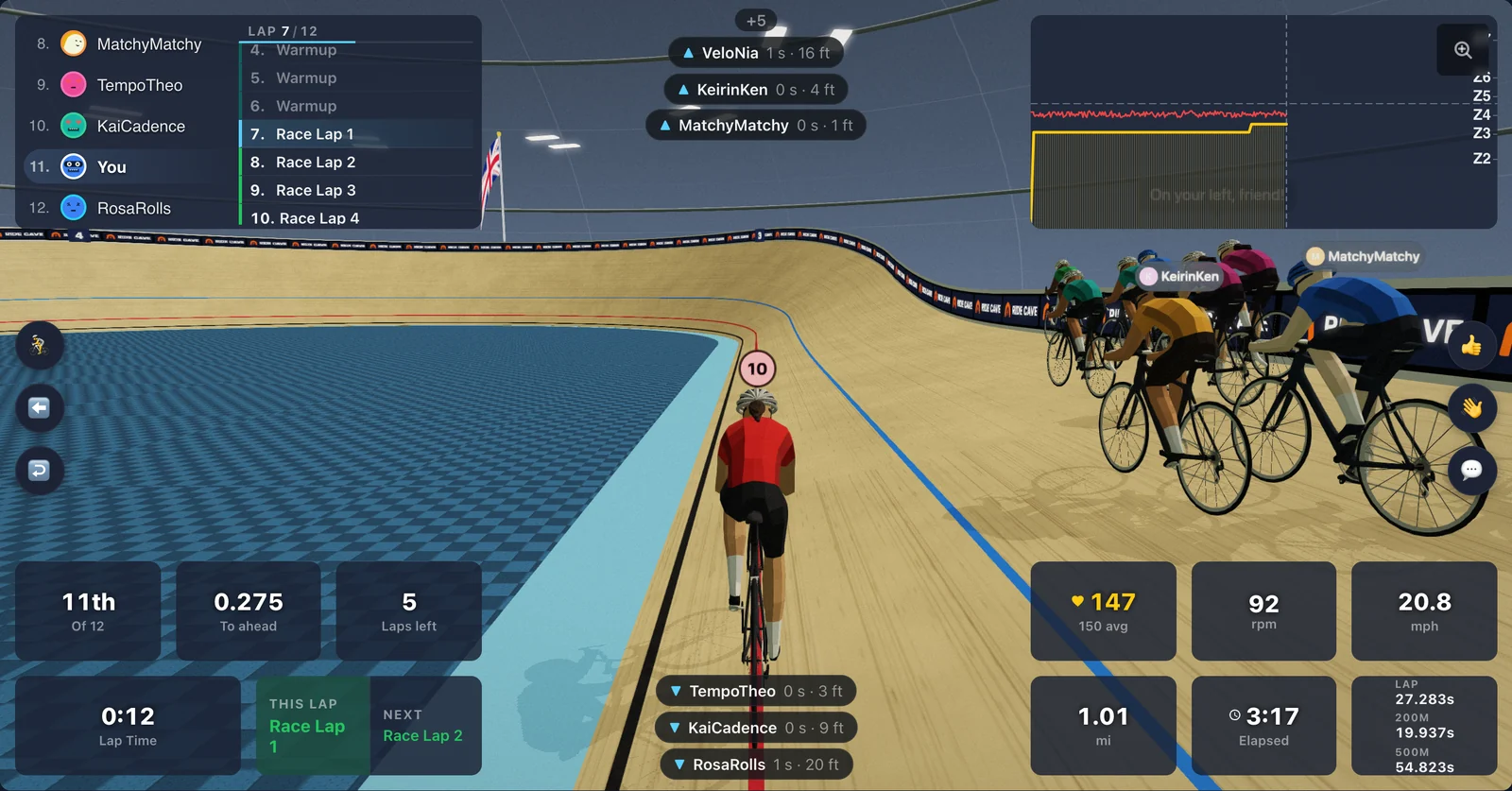
The speed gap between you when your hands meet decides how good the sling is. A perfect one hands over real speed: the rider coming in surges clear while the rider going out drifts off the back. A late one barely moves you. Too far apart in speed, or too far up the track, and you miss, and your partner rides on until they come round to you again.
- A speedometer over your head: the right speed is at 12 o’clock, left is too slow, right is too fast
- The camera turns round to show your partner coming
- The race radio calls your partner in and grades each sling
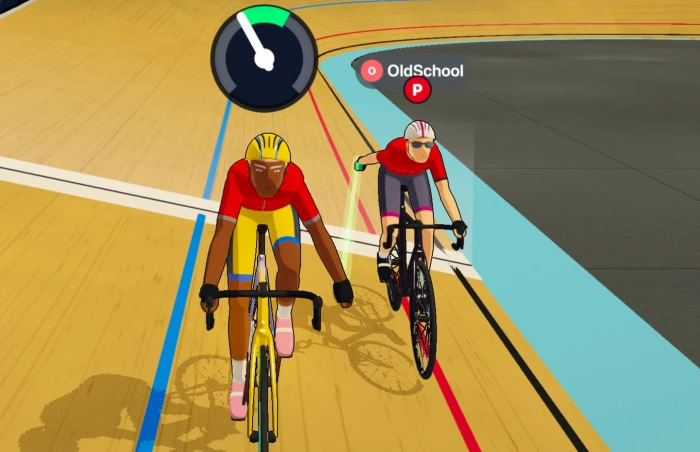
Powered by Cave Motion™.
Every rider’s arms do the real thing. The racer reaches back, the relief rider reaches down, and their hands meet at the sling. Every team on the track does it too, with a burst of light in the team’s color, so you can read the race from across the velodrome.
Your team
Know who is who at a glance.
Team kits
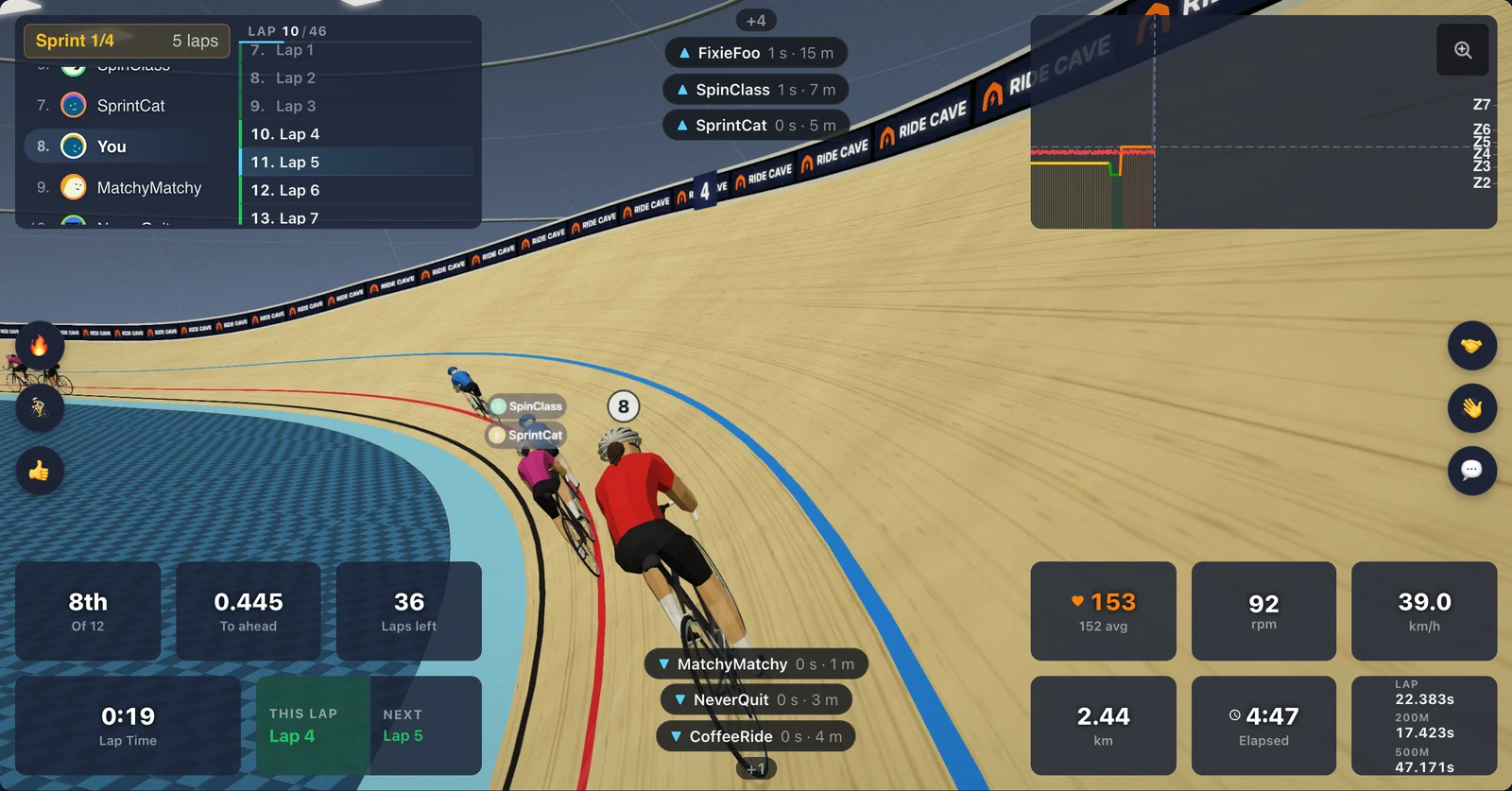
Every team has its own jersey color and pattern, Team Red, Team Blue and so on. The rest stays yours: your body, hair, helmet, bibs, shoes and bike.
A partner you can trust
In a race with bots, your bot partner is at your level and always comes down for your exchange. When it is your turn to come in, the timing is yours to get right.
Team standings
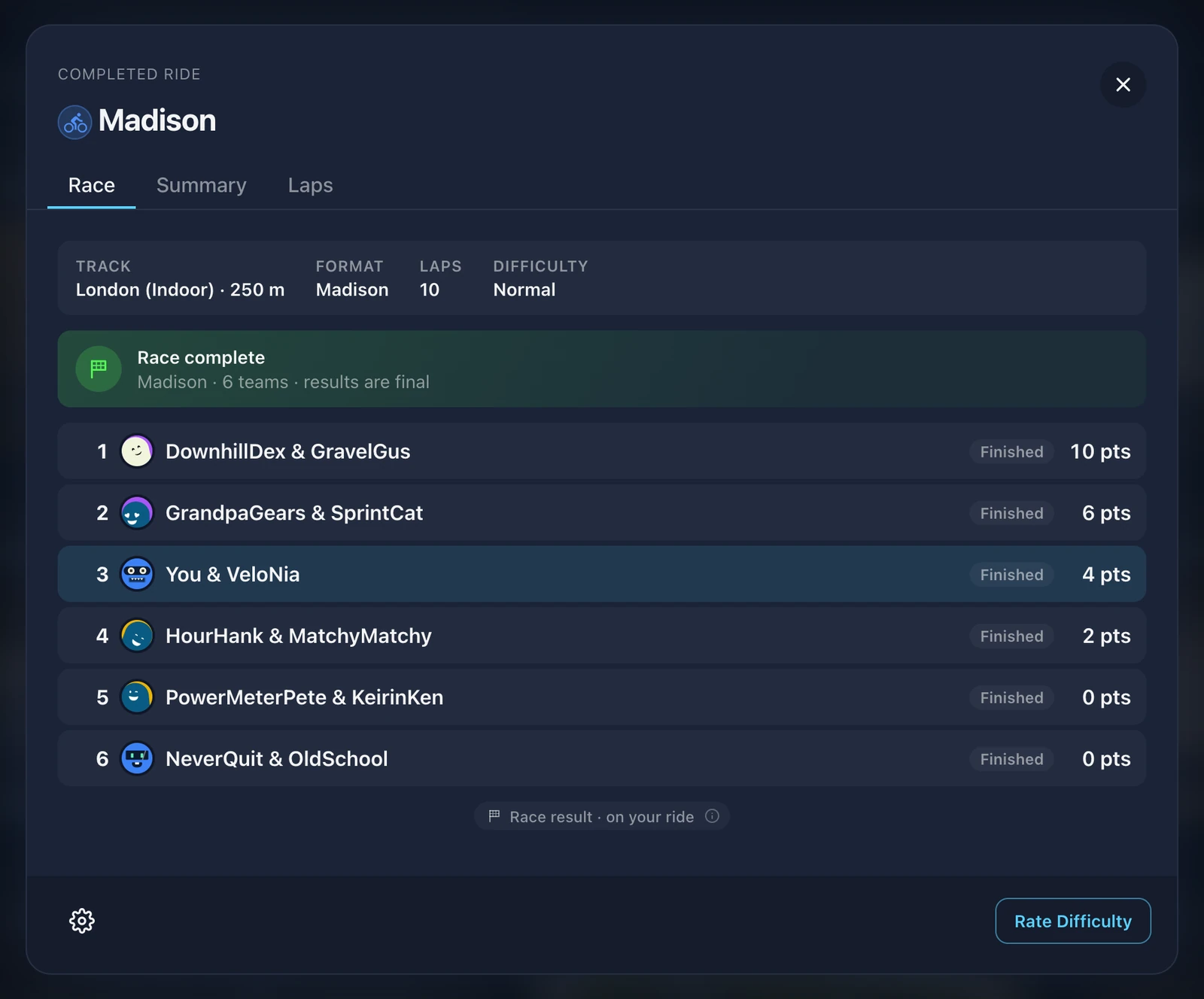
The leaderboard shows teams, not riders, with each team’s points and laps. Your ride list keeps the result, like 2nd of 6 teams.
How to race it
Two riders, one plan.
Really rest
The rest is what makes a Madison fast. Soft pedal at the boards, because you will need all of it when your turn comes.
Time the sprints
Get the stronger sprinter racing as the sprint lap comes round. A well timed exchange can decide who is fresh for the line.
Attack with a fresh rider
A lap is worth more than any sprint, and a fresh partner can carry a move that would finish a rider alone.
On Ride Cave
Ride it your way.
You and a partner against bot teams.
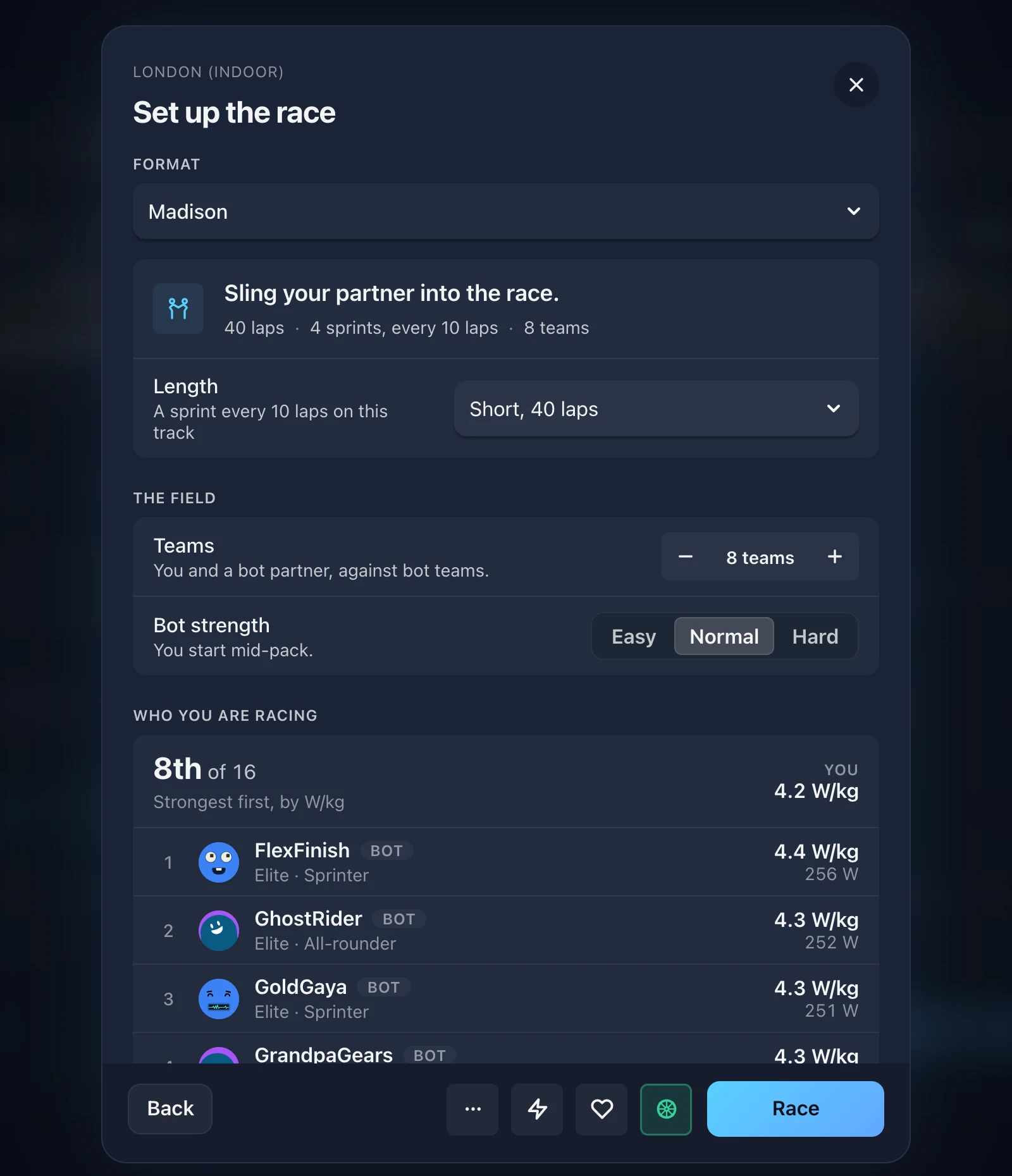
Choose from 2 teams up to 15, depending on the track, at Easy, Normal or Hard. The bot teams race with real tactics: they exchange, attack and go for the sprints.
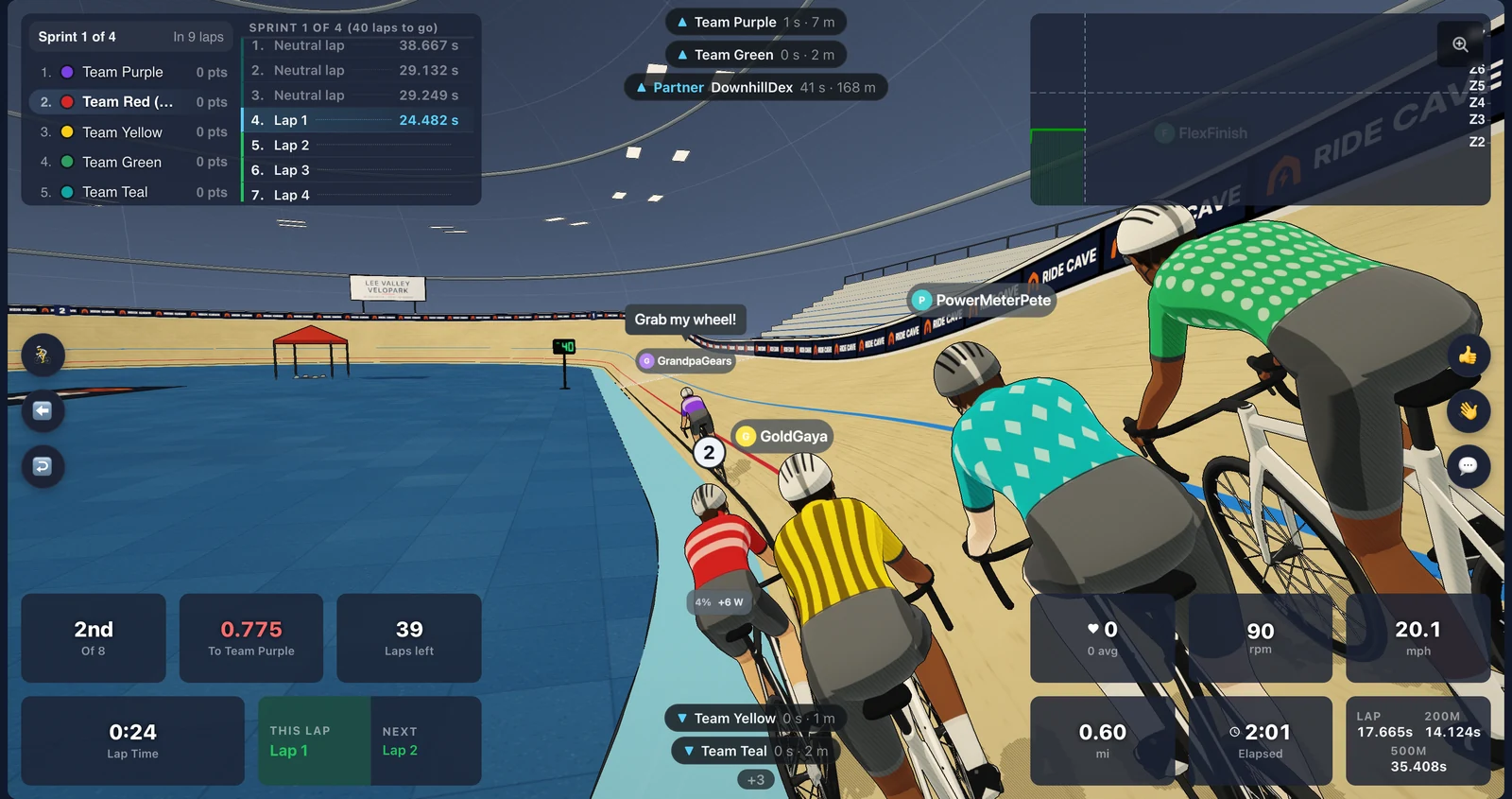
Set up in a few taps.
Choose the length and how many teams, pick the bots’ strength, and see who you are racing before you start.
Or race with a real partner.
Host a Madison as a Group Race for up to 30 real riders. The race room pairs everyone up for you, and a rider without a partner gets a bot at their level. Hosts choose the pairing: Balanced teams, Matched partners, Random. Both partners get the same place and XP in the official results.
A result for the team.
Your ride summary opens on the team standings: every team in order with its points, and both partners take the same place. Every race earns XP and a badge in your ride list.
The settings
What you can set.
| Length | Short (about 10 km), Standard (about 20 km), Championship (about 30 km), or 10 to 240 custom laps |
|---|---|
| Sprints | By the track, as the UCI rules set them: every 10 laps under 333.33 m, every 8 on 333.33 m, every 5 above it |
| Teams | Bot races: 2 up to 15, by the length of the track. Group Races: every rider who joins, up to 30 |
| Pairings | Group Races only: Balanced teams, Matched partners, Random |
| Your trainer | ERG Racing Mode stays off in a Madison, so you can soft pedal when you rest |
Questions
Good to know.
What is a Madison in track cycling?
A team race for pairs. One rider races while the other rests, and they swap with a touch, usually a hand sling. Teams score points in the sprints and by gaining laps, and the most points wins. It takes its name from Madison Square Garden in New York, home of the six day races where it began.
Do I need a partner to try it?
No. In a race with bots you get a bot partner at your level, against bot teams. To race with real partners, host a Group Race and the race room pairs everyone up.
What happens if I miss the exchange?
Nothing is lost but time. Your partner rides on and comes round to you again, and that pass is your next chance. Until then, the racing rider stays out and keeps working.
Is it hard to do on a trainer?
A speedometer over your head shows when your speed is right, and the speed window is wider than it would be on a real track, because a trainer is slower to change speed. It still takes a few goes to get a perfect sling.
Who picks the teams in a Group Race?
The host chooses how riders pair up: balanced teams, matched partners or random. The race room then sets the teams when the field is fixed.
More track racing
The other formats.
Scratch
First over the line wins. The purest race on the track.
Points
Points on the sprint laps, and a lap gained is worth more than any sprint.
Elimination
The last rider over the line is out, again and again, until one is left.
Tempo
After the first four laps, a point to the first rider over the line on every lap.
Keirin
A derny winds up the speed, pulls off, and the sprint is on.
Time trial
You against the clock, from a standing start, with no draft.
Find your partner.
Pick a velodrome, choose Race, then Madison. Your partner is waiting at the boards.